
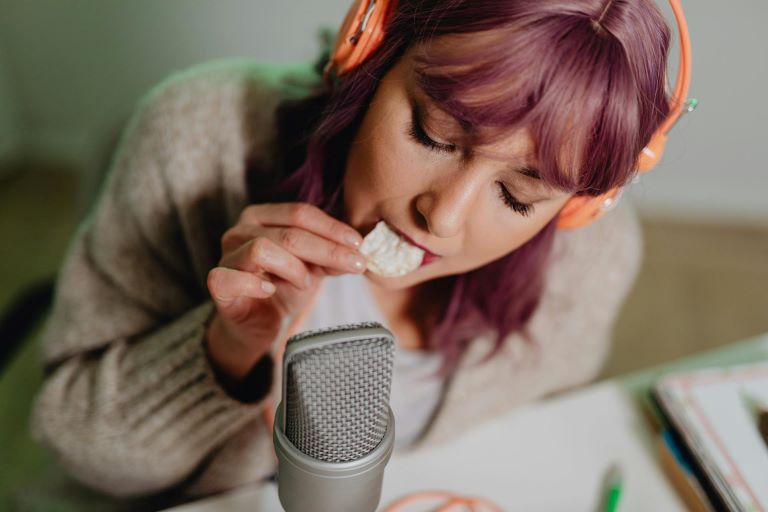

SOUND ON
Consumers crave memorable and immersive experiences, and “multi-sensory” has become the buzzword shaping today’s food and beverage trends. While not new, this movement continues to evolve. Trendincite LLC has been tracking it for over two decades. To innovate, brands are spotlighting sound and texture, while researchers are exploring how audio influences taste perception, and companies are merging sound into sensory branding. Sound and texture are becoming increasingly important and are beginning to rival flavor. Beyond the industry, artists and museums are also experimenting with sound and playing with emotional connections.
SCIENCE AND SOUND
Researchers study how sound impacts taste and alters flavor perception. Professor Charles Spence, an experimental psychologist at Oxford University, coined the phrase “sonic seasoning.” The term describes how sound can enhance or modify the flavor of food and drink. He states, “Sound is undoubtedly the forgotten flavor sense.” For example, Oxford researchers found 72% of participants rated stale chips as fresh when crunch sounds were altered through headphones.
Dr. Natalie Hyacinth, a composer and sound expert at the University of Bristol, discovered that the brain uses “multisensory integration,” and senses start to mingle when sounds are introduced. Her research found that “lush tunes in a major key make chocolate taste creamier and sweeter, while sharp notes increase bitterness.” To test this discovery, Dr. Hyacinth collaborated with Mars’ Galaxy Chocolate to create a musical soundtrack to enhance the chocolate experience. The goal is to turn chocolate into “a symphony for the senses” by pairing it with music. A poll of 2,000 Brits revealed that 37% consume a sweet treat for “me time,” and 56% turn up the music to chill out. The 90-second track, “Sweetest Melody,” is a 78-BPM track “designed to melt in your ears during the same amount of time that the chocolate melts on your tongue.”
In 2023, Lyle’s Golden Syrup commissioned the UK Brain Music Research Project with Split Second Research to help describe its taste. The team measured the brain activity of individuals eating syrup, marmalade, and butter, and then turned each into music. “Combining the EEG data and implicit responses allowed the researchers to create a series of musical tracks that vary, based on tempo, scale, instrumentation, chord progression, and melody.” Sound of Lyle’s soundtrack features a marmalade track at 135 beats per minute to highlight its tangy sweetness. The butter track displays gritty synths to demonstrate the salty undertones.
SOUND AND SENSORY BRANDING
Restaurants, brands, and companies are incorporating sounds into sensory branding. For instance, on November 13, 2025, Canadian restaurant Burdock & Co. hosted the Taste Sound: Radicchio Edition event in partnership with Tarun Nayar of Modern Biology. The dinner experience “is more than a meal with music – it’s a deep listen into the living, pulsing bio-energy of your plate. We’re turning the vibrant, complex character of radicchio into a living soundscape, transforming each bite into a multi-sensory revelation.”
For some individuals, the sound of chewing, crunching, slurping, and lip-smacking can cause intense anger, anxiety, or disgust, a condition known as misophonia. In 2023, Doritos debuted Doritos Silent, a “crunch-cancellation” technology designed for gamers to enjoy their favorite chips without distracting other players. Doritos found that many gamers dislike snack sounds – 46% in the UK, 30% in the U.S., 68% in Portugal, and 64% Spain ranked crisps as the loudest and most irritating noise while gaming.
In 2014, Condiment Junkie, a British sensory branding firm known for sound design in advertising, conducted an experiment to test whether hot or cold water produces a distinct sound. They played sounds of hot and cold water being poured into glasses and asked people to identify which was which. 96% of people can tell the difference between hot and cold, just by the sound. Cold water is more viscous than hot water because its molecules move more slowly. The viscosity of a liquid affects how it pours and, therefore, how it sounds.
SOUND AND TEXTURE
In addition to science and sensory branding, the sound and texture of food and beverages are influencing consumers’ choices. Texture is becoming increasingly important and is beginning to rival flavor. “Texture as Flavor” is one of five 2026 trends John Koch, Founder of Koch Associates, identified. Koch states, “Crunch, chew, and contrast are driving flavor perception as much as taste. Texture is no longer garnish-it’s a flavor driver.” Similarly, nearly half of consumers now rank texture as equally important as flavor. Among younger generations, 75% of Gen Z and 80% of Millennials say it defines their cravings, according to Nestlé USA’s 2026 Food & Beverage Trends report.
Tastewise’s U.S. analysis found that over the past year, social discussions involving the term “crunchy” have increased by about 13%. 26% of restaurants in the U.S. currently offer items described as “crunchy” on their menus. Datassential called out “Texture Becomes a Menu Differentiator” as a 2025 trend. Words like “crispy,” “creamy,” “crunchy,” and “melt-in-your-mouth” on restaurant menus will drive consumer anticipation and satisfaction. Furthermore, according to Puratos’ global Taste Tomorrow’s survey of 23,000 consumers worldwide, 72% seek out foods with diverse textures. And 67% look for novelty in mouthfeel. Ingredion’s research found that 72% of people would switch brands if they were unhappy with a product’s texture.
Tastewise identified Sensory Maximalism as a top trend for 2026. “Food in 2026 is more than flavor. It is about how a meal feels, sounds, and looks.” One aspect is “The Great Texture Boom (Crack, Pop),” which describes consumers’ interest in texture. “People are chasing texture. They want food that cracks, pops, crunches, and melts.” According to Mintel and Black Swan, social conversations about “Texture Satisfaction” are on trend for this year, with 5% growth. Conversations about “Crunchy” are growing, up 57%, while “Gooey” rose 37%. These two textures are trends to watch for this year and next. The sound and texture of food and beverages are central to the consumer experience, shaping perception and satisfaction.
SOUND AND ART
Artists and museums are exploring sound and art using immersive experiences to engage individuals. For example, in the winter of 2025, Food Sound, an immersive exhibition on sound and food, ran at MUSE Science Museum in Trento, Italy. Visitors were guided through reconstructed trattorias and dining pods to learn how the brain processes sound and how acoustics can influence food choices. This immersive experience combined colors, shapes, light, shadow, iconic objects, and sound. During the summer of 2025, Feel the Sound was displayed at London’s Barbican Centre. It highlighted a series of multi-sensory participatory experiences that revealed sound’s physical, emotional, and immersive dimensions.
Sound is also appearing in public art. In September 2025, Artist Chloë Bass and Creative Time launched the If You Hear Something, Free Something sound art project in NYC’s Subway Sound System. Bass broadcast questions on subway mezzanines across NYC’s boroughs, asking how we live together. She asks us, “If we change what we hear, can we change how we feel, and become better neighbors?”
Sound and texture are shaping food and beverage experiences. From research to art, brands are experimenting with sound and texture to create novel and immersive experiences. Watch for new research, unique textures, and accompanying sounds.
Sound off. Let Trendincite LLC compose a custom multi-sensory trend excursion, an audible marketing presentation, a textural blog post, or hire Amy Marks-McGee as a guest speaker.